
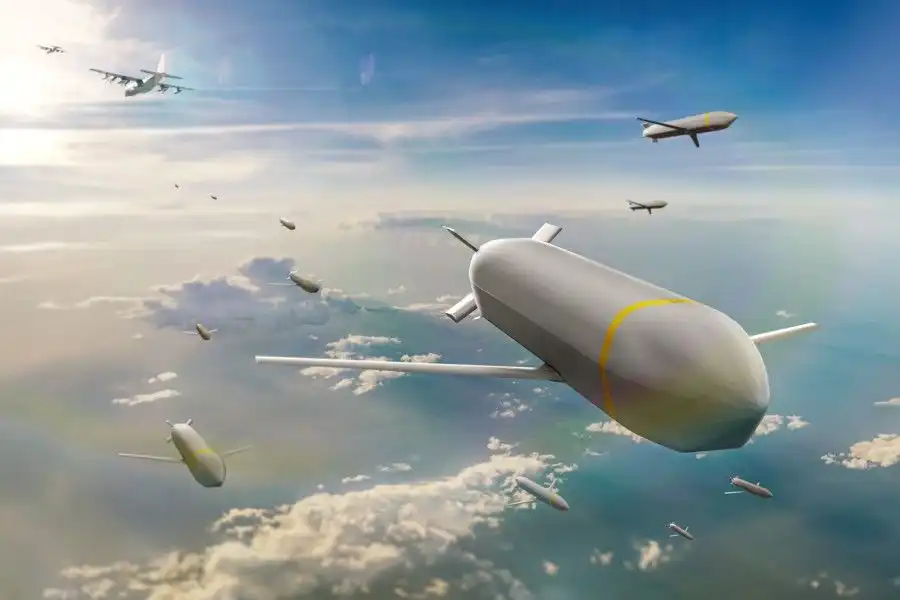
U.S. Air Force Explores New Lugged Affordable Cruise Missile for Mass Production
The U.S. Air Force is taking its next steps toward fielding a new class of Lugged Affordable Cruise Missiles (LACM), issuing a request for information (RFI) aimed at finding cost-effective and quickly deployable solutions from industry. This new initiative could mark a major shift in how the service expands its precision strike capabilities under constrained budgets.
What is the LACM?
According to the Air Force’s RFI, the LACM is designed as a 500-pound-class weapon carrying at least a 100-pound warhead. The missile should be able to operate in contested communications environments and deliver performance for a unit cost of $300,000 or less; a notably affordable benchmark compared to legacy systems.
The service aims to begin delivery of the new missile as soon as April 2026, with a longer-term vision of scaling up production to 1,000 missiles per year.
Performance Expectations and Design Goals
The Air Force outlines specific characteristics for the LACM, including:
- Range: At least 250 nautical miles
- Low-altitude Flight: Capable of flying 100 nautical miles under 1,000 feet
- Modularity: Designed with open systems architecture to allow faster upgrades
- Mounting Type: A “lugged” configuration, meaning it can be attached via pylons to wing hardpoints or internal weapons bays
The missile is also expected to be compatible with both U.S. and allied fighter aircraft, expanding deployment flexibility across a variety of combat platforms.
LACM in Context: Affordable Mass and Future Airpower
The LACM effort arrives amid the Pentagon’s broader push toward “affordable mass” – developing lower-cost munitions that can be produced and fielded in high volumes. The Defense Department’s FY26 budget, shaped under the Trump administration, places strong emphasis on expanding munitions capacity, including through initiatives like the Family of Affordable Mass Missiles (FAMM).
Though FAMM and LACM are distinct efforts, both support the Pentagon’s desire for scalable, cost-effective solutions in an era of rising demand for dispersed, high-volume missile strikes.
Industry Participation and Emerging Players
In addition to defining technical parameters, the RFI encourages vendors to demonstrate their ability to integrate LACM onto fighter aircraft, both domestic and foreign. The modularity and affordability are designed to foster competition and keep a diverse vendor base engaged.
Notably, other Pentagon-funded efforts; such as the Defense Innovation Unit’s Enterprise Test Vehicle, have already seen players like Anduril and Zone 5 Technologies step into the low-cost cruise missile space. These parallel programs could help accelerate the industrial foundation needed for LACM’s fast-track timeline.
Conclusion
The U.S. Air Force’s move to explore a lugged, affordable, modular cruise missile represents a critical shift in procurement strategy – one that prioritizes speed, scale, and flexibility over legacy complexity and cost. If executed successfully, LACM could play a pivotal role in reshaping aerial warfare and enabling the Air Force to maintain operational advantage in an increasingly contested battlespace.





One Comment